
Sindh provincial guide
SRB POS in Sindh: who must integrate
SRB POS integration is not a blanket rule on every restaurant in Sindh — it applies to the categories in the Schedule, including a Rs 5 million turnover test. Here is who is actually caught, and what the rate and the penalties are.
The system
What SRB POS integration is
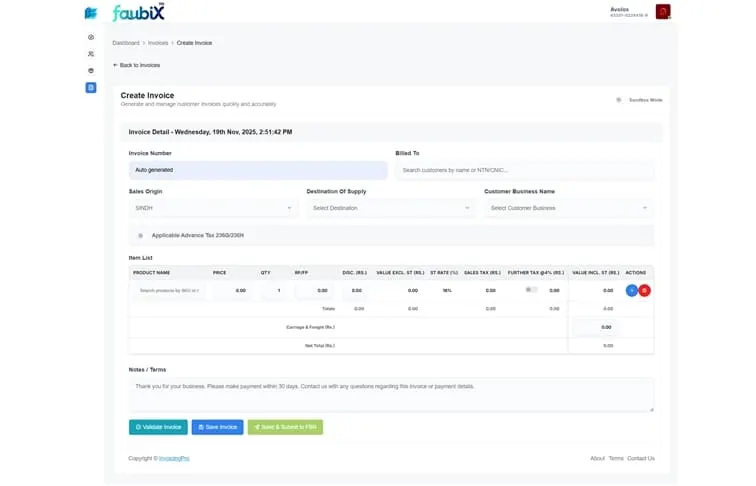
SRB POS integration connects the till in a Sindh service business directly to the Sindh Revenue Board’s computerised system, so that each taxable sale is reported as it happens rather than summarised in a return weeks later. The receipt the customer takes away carries an SRB invoice number and a QR code, which is what makes the transaction verifiable after the fact.
The mechanism sits in the Sindh Sales Tax Special Procedure (Online Integration of Business) Rules, 2022, notified as SRB-3-4/03/2022 on 21 February 2022 and consolidated since. The obligation those rules implement comes from the Sindh Sales Tax on Services Act 2011 — the provincial statute, not the federal Sales Tax Act 1990 that governs FBR digital invoicing.
Where integration applies, rule 3 requires all of that business’s points of sale to be connected, including those taking orders over the internet, and an online marketplace facilitating those services is caught in its own right. Rule 5 charges a service fee of one rupee per invoice generated, reported separately in the return, and rule 6 sets the particulars the invoice has to carry.
The component that receives the data is called the Sales Data Controller, or SDC. It matters more than its name suggests: it is also the path through which sales returns and exchange adjustments are handled, using credit notes. A refund at a Karachi counter therefore has a documented route, rather than being voided quietly in the POS and leaving the reported figure wrong.
Two systems, not one
SRB POS and FBR digital invoicing
They are separate systems under separate laws, run by separate authorities. Being compliant with one says nothing about the other.
FBR digital invoicing
- Run by the Federal Board of Revenue
- Sales Tax Act 1990, with the timetable in SRO 1852(I)/2025
- Covers goods and federally taxable supplies
- A single rate structure applies regardless of how the customer pays
- Invoice transmitted to FBR, which returns an FBR invoice number and QR
SRB POS integration
- Run by the Sindh Revenue Board
- Sindh Sales Tax on Services Act 2011, with the 2022 Online Integration Rules
- Covers only the services listed in the Schedule — restaurants, and beauty and physical well-being services
- The rate changes with the payment method: 8% digital, 15% otherwise
- POS sends data to the Sales Data Controller, which returns an SRB invoice number and QR
Scope
Who actually has to integrate
It is not every restaurant in Sindh. The rules apply only to registered persons providing a service listed in the Schedule, and the Schedule sets category tests. A single-branch standalone restaurant under the turnover figure is outside the mandate — which is the opposite of what most vendor pages say.
Under the Schedule substituted by Notification SRB-3-4/25/2026 with effect from 1 July 2026, a restaurant is caught if it meets any one of five tests: it is located in a hotel, motel or guesthouse; it is a franchiser or franchisee; it has more than one branch in Sindh; it is located in an air-conditioned shopping mall; or its turnover during the immediately preceding twelve tax periods exceeded Rs 5 million.
The second Schedule entry covers beauty and physical well-being services — beauty parlours and salons, beauty clinics, slimming clinics, gyms and physical fitness centres — under a similar set of category tests of their own.
Two things follow that are worth stating plainly. Hotels are not themselves in scope. Being located in a hotel is a criterion that pulls a restaurant or salon outlet in; it is not an obligation on the hotel’s own room revenue. And the mandate does not reach the health sector at large — a clinic providing medical services is not caught by an entry aimed at beauty and physical well-being.
The turnover figure has moved twice. It entered at Rs 10 million in August 2022, was cut to Rs 5 million on 31 July 2023, and remains Rs 5 million in the Schedule substituted for 1 July 2026. A page quoting Rs 10 million is describing a position that ended three years ago, and one quoting no threshold at all is describing a rule that has never existed.
Note also how differently this is drawn from Punjab. PRA’s E-IMS enforcement names four four categories in its enforcement drive, but its actual e-IMS test is turnover — Rs 6 million for restaurant services and Rs 10 million for others. Sindh frames the duty around scheduled services plus category tests, one of which is turnover. A business can sit inside SRB’s scope and outside PRA’s, or the reverse. If you operate in both provinces you are answering two different questions, not one question twice.
The rate
What the customer pays with changes what they are charged
Sindh ties the rate to the payment method on each individual bill. The same meal, at the same restaurant, on the same evening, carries a different rate depending on whether the customer taps a card or hands over cash.
- 8%
- Where payment is by debit or credit card, mobile wallet or QR scan
- 15%
- Cash and any other payment channel
- Rs 5m
- Turnover over the preceding twelve tax periods that brings a restaurant into scope
The 8% reduced rate sits in Part II of the Second Schedule and carries a condition: no input tax credit or adjustment is admissible at that rate. Restaurants and cafés may instead apply to SRB for a special dispensation to charge 15% on digital payments and keep input adjustments. Rates and scope are set by notification and change — confirm your position with a qualified tax adviser.
Why it matters operationally
A rate that moves per bill is a systems problem
A rate that depends on the payment method cannot be handled by a menu price and a calculator. The till has to know how the bill was settled before it can compute the tax, which means the payment step and the invoicing step are no longer independent — and a split payment, part card and part cash, has to be resolved rather than guessed.
This is where a counter set up for federal invoicing alone tends to break. FBR’s structure does not vary with the payment channel, so a system built only for it usually computes tax before payment is taken. In Sindh that ordering is wrong, and the error is invisible until a reconciliation or an audit surfaces it months later.
The reduced rate is not free, either. Input tax credit is not admissible at 8%, so a restaurant with meaningful input tax may be worse off on card sales than the headline difference suggests. That is exactly why the special dispensation exists: charge 15% across the board, keep input adjustments, and remove the branching from the counter entirely. It is a pricing decision with tax consequences, so it belongs with your adviser — but it is worth knowing the option is there before rebuilding a till around per-payment logic.
Exposure
What non-integration costs
Rs 100,000 is the floor, not the ceiling. A good deal of published material still quotes Rs 100,000 as the maximum. That describes the regime as it stood before 1 July 2024, and understates current exposure by a factor of ten.
The operative provision is Serial 2B of section 43 of the Sindh Sales Tax on Services Act 2011, as substituted by the Sindh Finance Act 2024 with effect from 1 July 2024. A person who avoids, defies or fails to comply with the e-invoicing system, issues invoices outside it, or refuses, denies or obstructs enforcement of section 54A is liable to a penalty of up to Rs 1,000,000, but not less than Rs 100,000.
Two further consequences sit in the same entry. On repetition of the offence the business premises are liable to be sealed. And on conviction by a Special Judge the person is further liable to imprisonment of up to one year, or a fine of up to Rs 100,000, or both.
You may also see Serial 7B cited, carrying a penalty of Rs 100,000 or an amount equal to the tax involved, whichever is higher. That entry was inserted by the Sindh Finance Act 2017 and omitted by the Sindh Finance Act 2024. It is not live law, and a page relying on it is describing a provision that has not existed since June 2024.
A separate entry, Serial 2A, deals with failure to issue a tax invoice under rule 29 of the Sindh Sales Tax on Services Rules 2011 — Rs 20,000 on a first default and Rs 50,000 for each subsequent one. Which entry a particular default falls under depends on your own facts, so take advice rather than reading a number off a range.
Corrections
What people get wrong about SRB
Every restaurant in Sindh must integrate with SRB POS.
The duty applies only to registered persons providing a scheduled service, and restaurants are caught by category: in a hotel, motel or guesthouse; a franchiser or franchisee; more than one branch in Sindh; in an air-conditioned mall; or turnover above Rs 5 million over the preceding twelve tax periods. This error usually comes from quoting SRB’s FAQ answer without the question, which is explicitly limited to restaurants falling in the Schedule.
Hotels are covered by the POS mandate.
They are not. The Schedule has two entries: restaurants, and beauty and physical well-being services. Being located in a hotel is one of the tests that brings a restaurant or salon into scope — it places no obligation on the hotel’s room revenue.
The maximum penalty is Rs 100,000.
That was the position before 1 July 2024. Serial 2B as substituted by the Sindh Finance Act 2024 runs to Rs 1,000,000, with Rs 100,000 as the minimum, plus sealing on repetition and possible imprisonment on conviction. The old Serial 7B that carried the Rs 100,000-or-tax-involved formula was omitted by the same Act.
The 8% card rate is simply better for the restaurant.
No input tax credit or adjustment is admissible at the reduced rate. A restaurant with meaningful input tax may prefer to apply for the special dispensation, charge 15% on digital payments and keep its adjustments. The arithmetic depends on your own input position.
We are FBR-integrated, so Sindh is covered.
Different authorities under different statutes. Federal integration does nothing for a Sindh services obligation. Section 73A, inserted by the Sindh Finance Act 2026, also lets SRB share taxpayer particulars with other authorised federal and provincial authorities, which makes a mismatch easier to surface than it used to be.
Getting compliant
How a Sindh rollout runs
Scope first, because the answer for a single-site restaurant may be that no integration is required at all.
Test yourself against the Schedule
Hotel or mall location, franchise status, branch count, and turnover over the preceding twelve tax periods.
Settle the rate question
Per-payment 8% and 15% without input credit, or apply for the dispensation and keep adjustments at 15%.
Connect to the SDC
Every point of sale, internet orders included, reporting to the Sales Data Controller with the rule 6 particulars.
Prove returns work
Refunds and exchanges route through credit notes, so a return is documented rather than voided at the till.
Not sure whether the Schedule catches you?
Book a short call. We will walk the category tests with you before you spend anything — and tell you plainly if you are out of scope.
FAQ
Questions
Scope, rates, penalties, and how SRB sits next to the federal obligation.
Is SRB POS integration mandatory for every restaurant in Sindh?
No, and this is the most common error written about SRB. The obligation applies only to registered persons providing a service listed in the Schedule to the Sindh Sales Tax Special Procedure (Online Integration of Business) Rules, 2022. Under the Schedule substituted with effect from 1 July 2026, a restaurant is caught if it is located in a hotel, motel or guesthouse; is a franchiser or franchisee; has more than one branch in Sindh; is located in an air-conditioned shopping mall; or had turnover exceeding Rs 5 million in the immediately preceding twelve tax periods. A single-branch standalone restaurant meeting none of those is not required to integrate.
Is SRB POS integration the same as FBR digital invoicing?
No. SRB POS integration is for Sindh sales tax on services under the Sindh Sales Tax on Services Act 2011, administered by the Sindh Revenue Board. FBR digital invoicing is federal, under the Sales Tax Act 1990. A Karachi restaurant that is also federally registered can owe both, and being compliant with one says nothing about the other.
Are hotels covered by the SRB POS mandate?
Hotel and accommodation services are not themselves in the Schedule. Being located in a hotel, motel or guesthouse is one of the criteria that brings a restaurant or salon outlet into scope — it is not an obligation on the hotel’s room revenue. The Schedule has two entries: restaurants, and beauty and physical well-being services.
Which businesses besides restaurants have to integrate?
Beauty and physical well-being services — beauty parlours and salons, beauty clinics, slimming clinics, gyms and physical fitness centres. Those are caught by their own set of category criteria in the Schedule. The mandate does not extend to medical services or to the hospitality sector generally, and scope is amended by notification, so check your specific category against SRB’s current text rather than a general list.
Why is the tax rate different for card payments in Sindh?
SRB applies a reduced rate to encourage documented payments. The standard rate for restaurant services is 15%, and under the Second Schedule the rate falls to 8% where payment against the tax invoice is received by debit or credit card, mobile wallet or QR scanning. Cash and any other channel stay at 15%. Two conditions matter: no input tax credit or adjustment is admissible at the reduced 8% rate, and the 8% is not automatic for every integrated restaurant.
Can a restaurant charge 15% on card payments instead?
Yes. Restaurants and cafés may apply to SRB for a special dispensation to charge the standard 15% on digital payments and claim input tax adjustments, which keeps menu pricing consistent across payment methods and preserves input credit. Whether that is better for you depends on your input tax position and your pricing, so it is a decision for your adviser rather than a default.
What is the Sales Data Controller?
The Sales Data Controller, or SDC, is the component of the SRB POS system that receives transaction data. It also handles sales returns and exchange adjustments through credit notes, so a return has a documented path rather than being voided silently at the counter.
What are the penalties for not integrating with SRB POS?
Serial 2B of section 43 of the Sindh Sales Tax on Services Act 2011, as substituted by the Sindh Finance Act 2024 with effect from 1 July 2024, provides for a penalty of up to Rs 1,000,000, and not less than Rs 100,000, for avoiding or failing to comply with the e-invoicing system, issuing invoices outside it, or obstructing enforcement of section 54A. On repetition the business premises are liable to be sealed, and on conviction by a Special Judge the person is further liable to imprisonment of up to one year, or a fine of up to Rs 100,000, or both. Note that Rs 100,000 is the floor, not the ceiling.
Does SRB share data with FBR?
Not by name. The Sindh Finance Act 2026 inserted section 73A into the Sindh Sales Tax on Services Act 2011 with effect from 1 July 2026. It makes taxpayer particulars confidential as the general rule, and then permits disclosure to a department or authority of the Federal or a Provincial Government authorised to access it, or under an agreement SRB makes with such an authority to enforce a tax it collects. That covers FBR, but it equally covers PRA, KPRA, NADRA and others, and it does not by itself create an SRB–FBR data feed.
Continue
Related guides & product
The Punjab equivalent, the federal obligation, and the counter software behind both.
SRB POS software
What running SRB and FBR from one counter looks like, and how to check your scope.
Read morePRA E-IMS (Punjab)
The Punjab equivalent — different scope test, different penalties, same underlying direction.
Read moreWhat is FBR digital invoicing?
The federal obligation in plain English, and how it differs from a provincial one.
Read moreAre you actually in scope?
Why “mandatory for all restaurants” is a misquote of SRB’s own FAQ, and what the five Schedule tests really say.
Read moreReady to simplify your FBR digital invoicing?
Join 2000+ businesses that use eInvoicePro to make invoices and send them to FBR.